


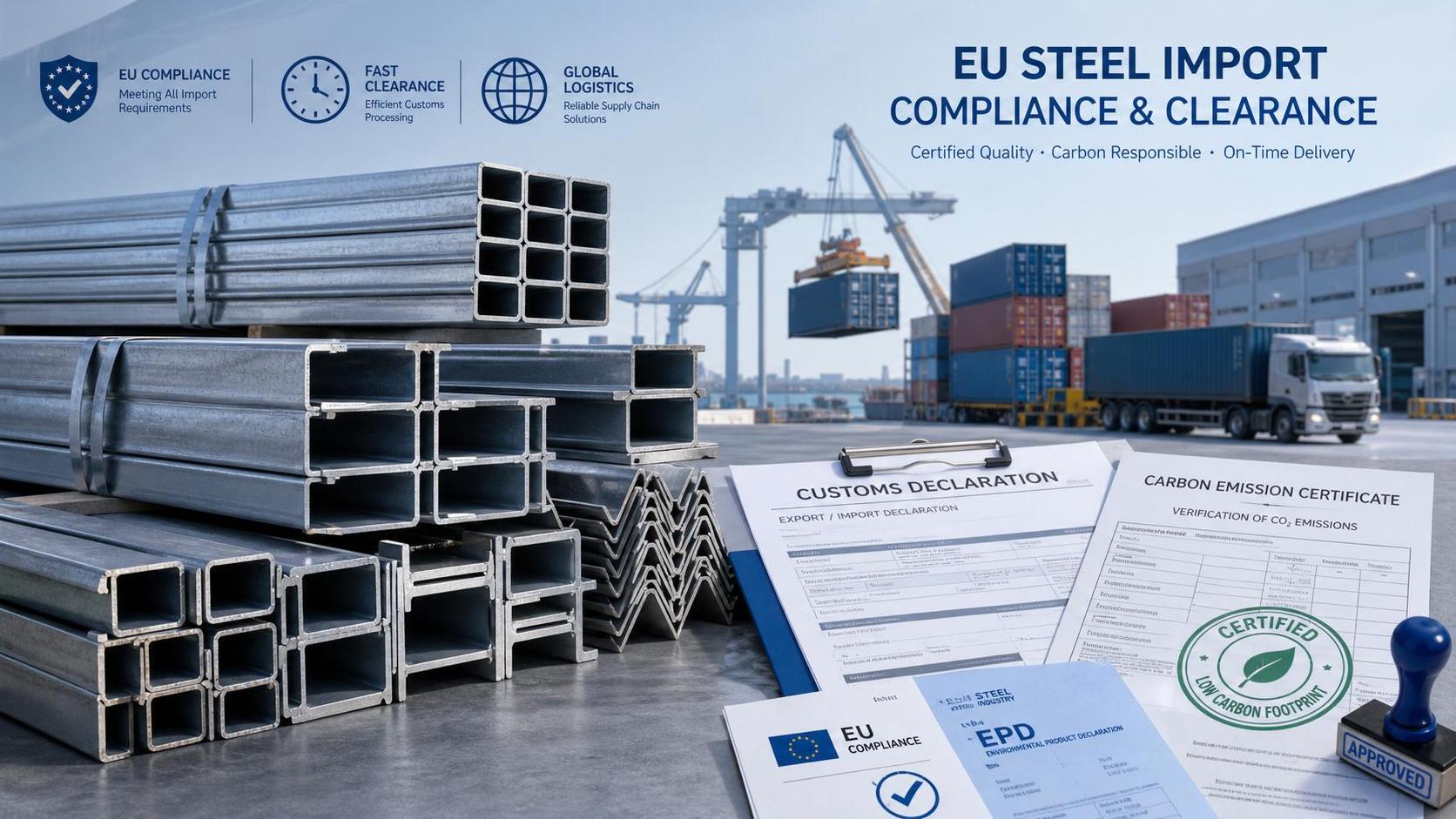
On July 16, 2026, the European Commission formally moved CBAM for steel into its third implementation stage for certain structural steel products entering the EU. For import flows covering hot-rolled HSS, cold-formed sections, and structural profiles under HS codes 7216.31-7216.99, certified embedded carbon emissions data must now be filed together with customs documentation. This matters directly to exporters, importers, compliance teams, logistics coordinators, and certification-related service providers because the rule change is tied not only to reporting, but also to customs clearance and delivery timing.

What Has Now Taken Effect at the Border
The confirmed change is that, from July 16, 2026, CBAM entered its third implementation stage for the relevant steel product categories imported into the EU. The products identified in the provided information are hot-rolled HSS, cold-formed sections, and structural profiles classified under HS codes 7216.31-7216.99.
For those imports, certified embedded carbon emissions data must be submitted together with the customs declaration documents. The provided information also states that non-compliant declarations may lead to customs clearance delays or return of the goods. It further confirms that the requirement directly affects compliance preparation, third-party verification cost, and delivery lead time for Chinese structural steel exporters.
Where the Pressure Is Likely to Appear First
Export shipments facing a new documentation gate
From an industry perspective, exporters shipping the covered structural steel products to the EU are the first group likely to feel the operational effect. The reason is straightforward: the embedded carbon data is no longer separate background information, but part of the documentation package that must move together with customs filing. In practice, the main pressure point is whether shipment paperwork, product classification, and certified emissions data are aligned before goods reach the customs stage.
Import and procurement teams dealing with timing risk
EU-side importers and procurement functions may also face immediate exposure because the rule affects whether goods can clear on schedule. Observably, the issue is not limited to environmental reporting; it also touches purchase timing, receiving schedules, and delivery commitments. What deserves closer attention is whether suppliers can provide compliant documentation in time for customs processing, especially for contracts or purchase plans involving the covered HS codes.
Verification and compliance service work becoming more operational
Certification-related businesses and third-party verification service providers are likely to see the requirement as an execution issue rather than a purely formal one. The provided information already points to verification cost as a direct impact for Chinese exporters. Analysis shows that the burden is likely to concentrate in document readiness, review sequencing, and coordination between exporters and external verification parties, because the certified emissions data must accompany the customs submission.
Logistics and delivery coordination under tighter sequencing
Supply chain and logistics participants may be affected where shipment booking, customs filing, and handover schedules depend on complete compliance documents. Since non-compliant declarations may result in delays or return of cargo, delivery planning for covered products may require closer document checks before dispatch and before customs submission. For businesses working on tight delivery windows, the rule change is therefore relevant to shipment sequencing as much as to compliance itself.
What Companies Should Watch Closely Now
Check whether the product scope is captured correctly
Analysis shows that one practical starting point is product scope confirmation. Companies involved in exports to the EU should pay close attention to whether their goods fall within the covered categories and HS codes listed in the provided information. For businesses handling multiple section types or mixed shipments, this is a basic compliance checkpoint rather than a secondary detail.
Prepare emissions documentation as part of customs readiness
What deserves closer attention is the sequencing of documents. The rule described here requires certified embedded carbon emissions data to be submitted together with customs documents, so companies should treat that information as part of customs readiness rather than as a later supporting file. Where internal review, supplier coordination, or external verification takes time, the timing of document completion may affect shipment release and delivery planning.
Reassess lead time and external verification cost exposure
The provided information already identifies third-party verification cost and delivery cycle impact as direct issues for Chinese structural steel exporters. Observably, companies may need to pay closer attention to whether existing lead times still reflect the added compliance step. This is not yet a basis for broad conclusions about market outcomes, but it is a reasonable area for operational review in export scheduling and contract execution.
Continue tracking how execution is interpreted in practice
The available information confirms the filing requirement and the risk of delay or return for non-compliant declarations, but it does not provide further operational detail. For that reason, companies should continue watching for later clarification in official wording, customs practice, certification expectations, tender documentation, and counterpart requirements. At this stage, that remains a monitoring priority rather than a confirmed change in every downstream procedure.
Why This Looks More Like an Execution Signal Than a Headline Change
Analysis shows that this development is better understood as a rule now moving into practical border execution for a defined set of structural steel imports, rather than as a general policy discussion. The key signal is that embedded carbon data for the covered products must accompany customs filing and that non-compliance carries immediate trade handling consequences.
At the same time, it is more appropriate to understand this as a live compliance development that still requires observation in day-to-day application. The confirmed facts establish the obligation and the potential customs outcome, but market practice will depend on how certification workflows, document review, and shipment handling are carried through by the parties involved.
How to Read This Development at the Current Stage
In practical terms, this event points to a more document-driven import threshold for covered structural steel products entering the EU. The immediate significance lies in compliance preparation, customs coordination, verification cost, and delivery reliability rather than in any broader market conclusion that has not yet been confirmed.
From an industry perspective, the most balanced reading is that this is an implemented rule change with direct operational consequences, while its full execution pattern still deserves continued attention. Companies connected to the covered product lines should therefore read it as a current compliance requirement and a trade execution signal, not merely as a policy update for background reference.
Basis of This Article and What Still Needs Verification
This article is generated from the user-provided news title, event date, and event summary. The analysis is based only on the confirmed information provided in that input.
For events of this type, commonly relevant source categories may include official announcements, releases by regulatory authorities, customs or trade administration information, industry association updates, standards-related documents, and reporting by established media outlets. A specific official source link was not provided in the input, so that point still requires follow-up verification.
Observably, the areas that still merit continued tracking include detailed implementation language, certification and verification interpretation, customs execution practice, tender or procurement document changes, industry feedback, and how companies in the affected trade chain are carrying out compliance in practice.
By clicking 'Allow All', you agree to the storage of cookies on your device to enhance site navigation, analyze site usage and assist with our marketing efforts.