


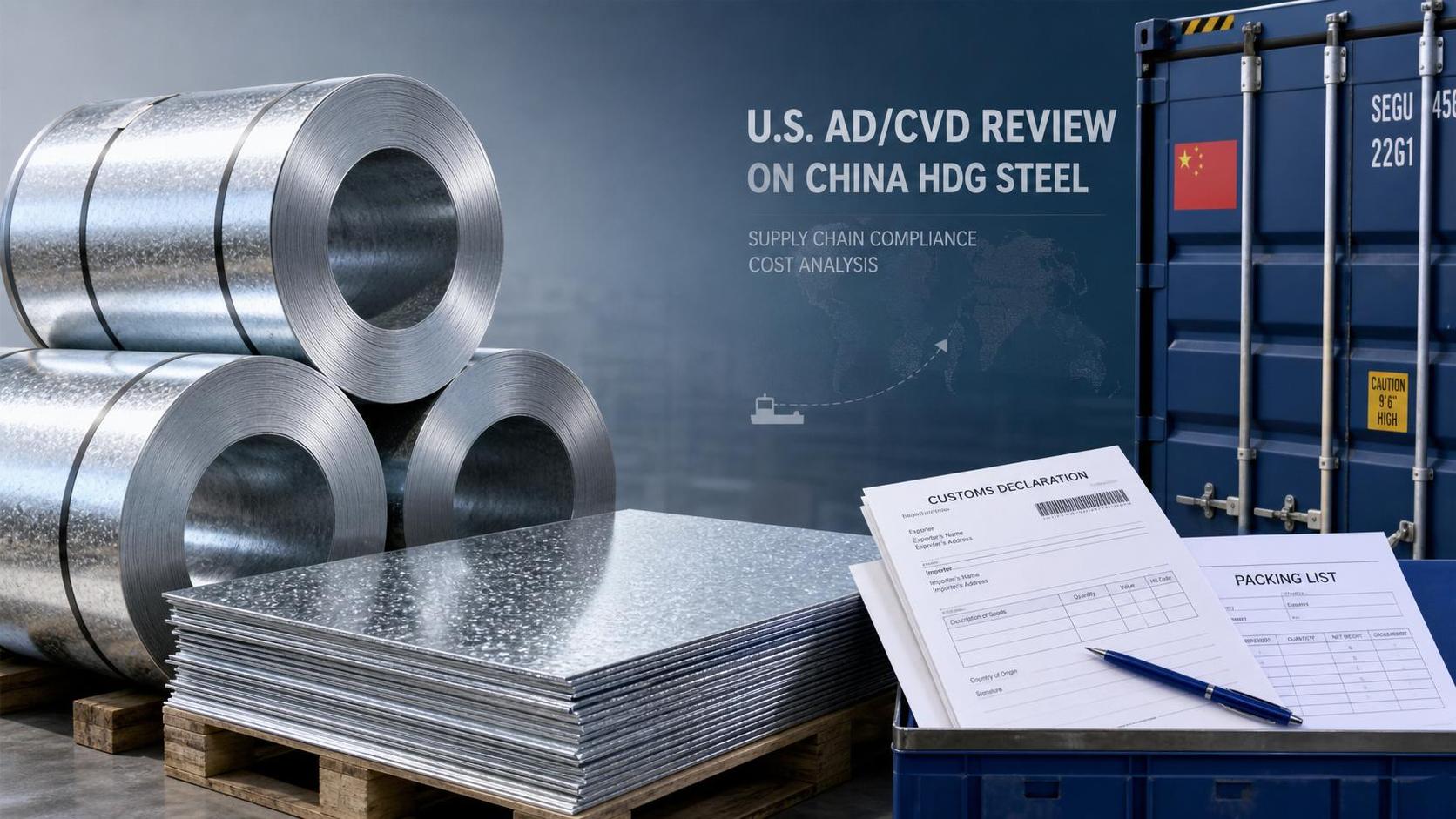
On July 27, 2026, the U.S. Department of Commerce formally opened the first period review of the antidumping duty order on hot-dip galvanized steel sheet (HDG) from China, covering export shipments made from January 1, 2025 through December 31, 2025. For the steel trade, this is not just a procedural update: it matters to U.S. importers managing customs cost exposure, to Chinese exporters preparing transaction and cost records, and to overseas distributors and end buyers facing tighter compliance checks and more complex document review in the second half of 2026.

What the review officially covers
The announced review period runs from January 1, 2025 to December 31, 2025. According to the information provided, the review concerns the first period review of the antidumping duty order on Chinese-origin hot-dip galvanized steel sheet. The U.S. Department of Commerce announced the start of this process on July 27, 2026.
The provided information also states that this review will directly affect U.S. importers in three practical areas: customs clearance cost, cash deposit obligations, and the duty rates that may apply over the next three years. At the same time, Chinese exporters are required to submit complete export transaction records, cost data, and related-party information.
Where pressure may build across the supply chain
Import-side exposure moves beyond filing formalities
From an industry perspective, U.S. importers are among the first parties likely to feel the operational impact because the review is tied directly to customs cost, deposit requirements, and future rate application. What deserves closer attention is that the effect is not limited to a single shipment decision; it can influence landed-cost calculations, budgeting assumptions, and the review of documentation attached to covered entries.
Exporters face a data-intensive compliance burden
Analysis shows that Chinese HDG exporters may be affected most immediately in the area of internal reporting and document preparation. The requirement to provide full export transaction data, cost information, and related-party details means the review reaches into pricing records, cost support files, and the consistency of commercial documentation. For companies with multiple counterparties or layered transaction structures, record accuracy may become a practical focus.
Distributors and buyers may see longer verification cycles
Observably, overseas distributors and end purchasers are not the direct target of the review, but they may still face higher compliance risk from the second half of 2026 onward. Based on the provided information, the main pressure points are likely to be supply-chain payment timing, document review complexity, and transaction confirmation steps tied to imports of covered products.
Service providers may need tighter coordination across documents and timelines
From an industry perspective, businesses involved in shipment coordination, customs support, and trade documentation may also need to adjust their workflows. The reason is straightforward: when document scrutiny increases, the consistency of records across export, import, and related-party disclosures becomes more important to the transaction process.
What companies should watch now
Track official wording and scope handling carefully
Analysis shows that companies involved in relevant HDG trade should watch how official language is presented and applied in follow-up stages of the review. The practical issue is that commercial decisions are often made based on operational interpretation, while review procedures depend on formal submissions and official definitions. That gap can affect how businesses assess exposure.
Prepare transaction, cost, and counterparty records early
What deserves closer attention is the readiness of export files and supporting records for the 2025 review period. Because the provided information specifically mentions export transaction data, cost data, and related-party information, companies may need to check whether records are complete, internally consistent, and traceable across contracts, invoices, and counterparties.
Reassess purchasing and delivery assumptions for late 2026
Observably, overseas buyers and distributors should focus on the operational side of compliance rather than treating the review as an abstract policy event. The information provided points to rising compliance risk, more complex document checks, and greater pressure on payment terms and delivery coordination starting in the second half of 2026.
Keep customer and supplier communication aligned with documentation
From an industry perspective, another practical area is communication. Where transactions involve covered HDG shipments, counterparties may need clearer alignment on shipment timing, document requests, and review-related responsibilities. This is especially relevant where delivery planning and payment arrangements depend on customs and duty treatment.
Why this is a signal worth following, not a final market outcome
Analysis shows that this development is better understood as a live compliance and cost-management signal than as a final market conclusion. The announced review creates a defined procedural pressure point around 2025 export shipments and raises practical questions for importers, exporters, distributors, and buyers. At the same time, the information provided does not establish final review results, so it is more appropriate to understand this as an active process that can shape business decisions before any ultimate outcome is known.
How to read the development at this stage
At this stage, the most balanced reading is that the review has immediate relevance for trade execution but should not be overstated as a settled result. Its importance lies in how it affects compliance preparation, customs cost planning, document control, and supply-chain coordination around Chinese HDG shipments tied to the 2025 review period. For the industry, the key point is continued attention rather than premature conclusions.
Basis of this article and follow-up verification
This article is based on the user-provided news title, event timing, and event summary concerning the U.S. Department of Commerce's launch of a period review on the antidumping duty order covering Chinese-origin hot-dip galvanized steel sheet. For this type of development, commonly relevant source categories may include official government notices, company disclosures, industry association updates, authoritative media reporting, and standards or trade-related documentation.
A specific official source link was not provided in the input, so further verification remains necessary as the review progresses. What deserves closer attention in follow-up monitoring is any later official wording related to procedure, data submission expectations, and the practical implications for import cost, deposit obligations, and document review across the supply chain.
By clicking 'Allow All', you agree to the storage of cookies on your device to enhance site navigation, analyze site usage and assist with our marketing efforts.