



China’s restart of the steel export licensing system on July 1, 2026 marks a concrete change in export control for selected engineering steel products rather than a routine administrative update. According to the joint notice referenced in the input, the first batch covers 12 categories including hot-rolled coil, H-beams and galvanized sections, and introduces quarterly quotas together with a front-end review tied to green and low-carbon compliance. For exporters, overseas buyers, distributors and supply chain service providers, the immediate relevance lies in how this may affect shipment timing, document readiness and the execution of longer-term supply commitments.
What the July 1 change formally puts in place
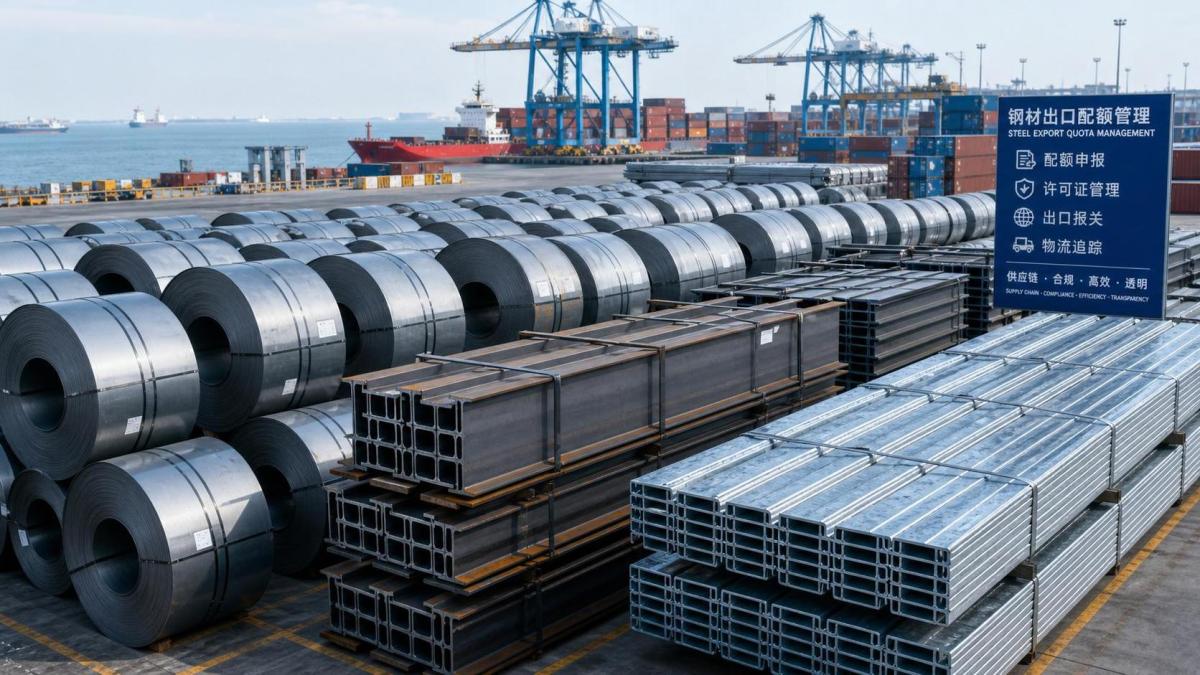
The confirmed change is that a steel export licensing regime will be fully reinstated from July 1, 2026 under a joint announcement by the National Railway Administration and the Ministry of Commerce referenced in the input. The initial scope includes 12 categories of engineering steel products, with examples provided in the input such as hot-rolled coil, H-beams and galvanized sections.
The same input states that the new arrangement combines quarterly quota management with a pre-review requirement linked to green and low-carbon compliance. It also states that the change will directly affect overseas importers’ purchasing schedules, customs clearance document preparation and the performance of long-term orders.
Where the pressure points may appear across the trade chain
Export sales and contract execution may need tighter sequencing
From an industry perspective, exporters are likely to feel the impact first in shipment planning and contract timing because quarterly quota control can affect when goods are available for export processing. What deserves closer attention is not only sales volume planning, but also whether contract milestones, production release and export filing can stay aligned once licensing becomes a gate before shipment.
Overseas importers and distributors may need earlier document coordination
Analysis shows that overseas importers, especially those relying on Chinese sections and related engineering steel supply, may need to move documentation work forward. The reason is straightforward: if licensing and green compliance review become preconditions, customs paperwork and procurement scheduling may no longer be handled as late-stage formalities. This matters in particular for distributors serving the EU, Southeast Asia and the Middle East, where supply continuity may depend on how early they lock in compliant cargoes and document sets.
Supply chain service providers may face more coordination work
Freight forwarders, customs support teams and other trade service providers may be affected because the rule change touches both timing and paperwork. Observably, the practical issue is whether shipping bookings, customs preparation and handover documents can match the new licensing rhythm. Even without further implementation detail in the input, the change signals that logistics coordination may become more sensitive to licensing status and document completeness.
What companies should watch before execution practices settle
Check whether covered products fall within the first regulated batch
Companies involved in hot-rolled coil, H-beams, galvanized sections and similar engineering steel products should first verify whether their exported items sit within the first 12 covered categories mentioned in the input. This is a basic but necessary step for exporters, traders and buyers reviewing upcoming orders and delivery commitments.
Prepare for compliance review as an early-stage trade condition
Analysis shows that the green and low-carbon review element deserves close attention because it is described as a front-end requirement rather than a post-shipment issue. Companies should therefore watch how compliance evidence, technical files, product descriptions and related trade documents may need to be organized before export arrangements proceed.
Revisit procurement and delivery calendars
What deserves closer attention is the interaction between quarterly quotas and long-term order execution. Businesses with recurring shipments or framework-style supply arrangements may need to reassess ordering cadence, delivery buffers and communication with downstream customers, especially where supply is tied to project schedules or distributor inventory planning.
Monitor official wording and market-side implementation signals
The input does not provide detailed operating rules, so companies should avoid assuming a fully settled execution model at this stage. It is more appropriate to track how official expressions, trade documentation expectations, buyer requirements and tender-related wording evolve after the restart takes effect.
Why this looks like both a live rule change and a continuing signal
Observably, this development should be read first as an implemented rule change because the restart date, covered product direction and the quota-plus-compliance structure are already defined in the input. At the same time, analysis shows that the market impact will depend on how the review standard, document expectations and transaction practices are applied in day-to-day trade.
That is why the development is not just about whether licensing returns, but about how export compliance becomes more tightly linked with planning, documentation and delivery. For the industry, the more useful reading is that an execution signal has already appeared, while important practical details still require close observation.
How to read the change at this stage
At this stage, the restart of steel export licensing is best understood as a formal policy shift with immediate operational relevance for covered steel exports. The confirmed facts already point to adjustments in quota planning, front-end compliance review and trade documentation workflows.
A neutral reading is that the change does not yet justify broad conclusions beyond the covered framework in the input, but it does justify closer monitoring by exporters, importers and channel partners whose business depends on stable supply from China. In practical terms, this is less a background policy story than a live compliance and delivery issue.
Basis of this article and what still needs verification
This article is generated based on the user-provided news title, event date and event summary. For developments of this type, commonly relevant source categories include official notices, releases from regulatory or trade authorities, customs or trade administration information, industry association updates, standard-setting documents and reporting by authoritative media.
No specific official source link was provided in the input, so the exact official publication path still requires follow-up verification. Ongoing attention should remain on any detailed implementation rules, compliance interpretation, tender document changes, market feedback and how companies actually execute the new requirements after July 1, 2026.
By clicking 'Allow All', you agree to the storage of cookies on your device to enhance site navigation, analyze site usage and assist with our marketing efforts.